
Related Articles

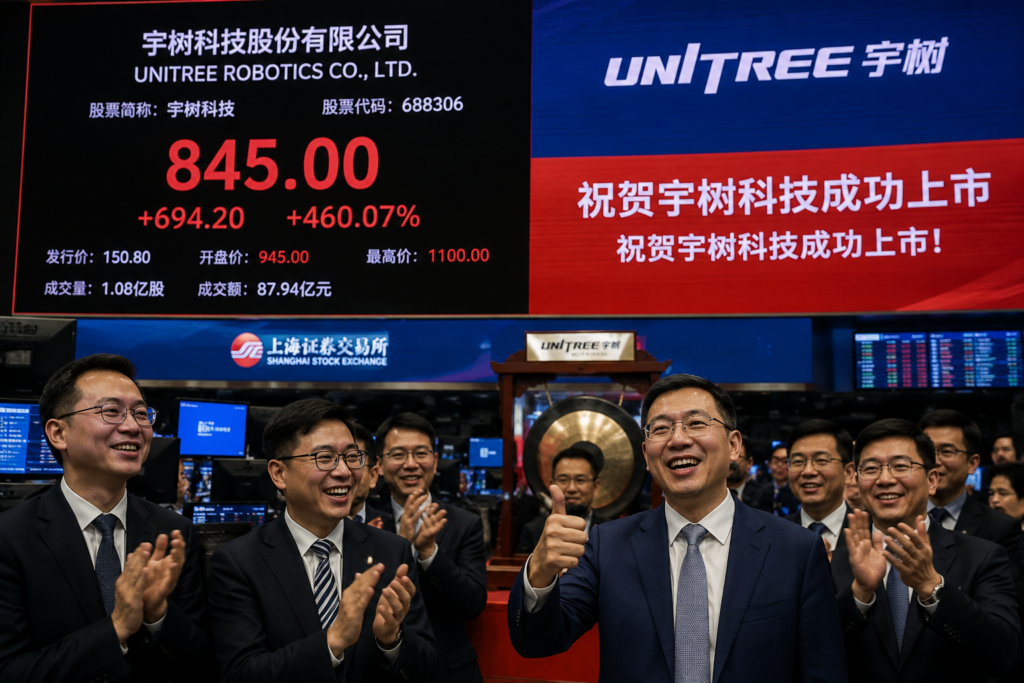
The Chinese robotics industry has taken another major step into the global spotlight after Unitree Robotics made a spectacular debut on the Shanghai Stock Exchange. Shares of the humanoid robot maker jumped as much as 629 percent during its first trading session, creating enormous excitement among investors and technology enthusiasts.
Unitree eventually closed its first trading day at 845 yuan per share, around 460 percent above its initial offering price of 150.80 yuan. The dramatic rise pushed the company’s market value to roughly $50 billion at its peak.
The performance has made Unitree one of the most closely watched robotics companies in the world. More importantly, its successful IPO shows how quickly investor interest in artificial intelligence, humanoid robots and embodied intelligence is growing.
Unitree Robotics Makes History in Shanghai
Unitree Robotics listed on the STAR Market of the Shanghai Stock Exchange on August 19, 2026. The company raised approximately 6.1 billion yuan, or about $904 million, through the IPO.
The company offered about 40.45 million new shares at 150.80 yuan each. The offering represented approximately 10 percent of its enlarged share capital. Investor demand before the listing was extremely strong, with retail subscriptions reportedly more than 8,000 times oversubscribed.
This level of demand was an early indication that investors were highly interested in Unitree and the broader robotics industry.
The first day of trading went far beyond normal expectations. Shares climbed rapidly after the market opened and reached an intraday high of 1,100 yuan. Although the stock later gave back part of those gains, it still finished the session at 845 yuan.
For a company entering the public market for the first time, such a move is extraordinary.
Why Investors Are Excited About Unitree
One of the biggest reasons behind Unitree’s popularity is its focus on humanoid and quadruped robots.
Unlike traditional industrial robots that normally perform specific tasks inside factories, humanoid robots are designed to operate in environments created for people. They can walk, move their arms, recognize objects and perform a growing range of physical tasks.
Unitree has become particularly well known for demonstrating robots that can run, dance, perform martial arts movements and maintain balance during complex movements.
These demonstrations have helped the company gain worldwide attention and have made Unitree one of the most recognizable names in Chinese robotics.
The company was founded in 2016 by Wang Xingxing in Hangzhou. Since then, it has developed robots, motors, sensors, motion control systems and other technologies needed to build advanced machines.
Its business is not limited to humanoid robots. Unitree also produces quadruped robots, which resemble four legged animals and are designed for different research, commercial and technical applications.
Strong Growth in Robot Sales
Unitree’s financial and sales growth has also contributed to investor confidence.
According to information released around the IPO, the company sold more than 33,000 quadruped robots and more than 5,600 humanoid robots between 2023 and 2025. Humanoid robot shipments exceeded 5,500 units during 2025 alone.
The company reported approximately 1.7 billion yuan in revenue during 2025, equivalent to around $250 million. More than 40 percent of its revenue came from overseas markets, showing that Unitree has already developed an international customer base.
This is important because the robotics industry is still at an early stage.
Many companies developing humanoid robots are spending heavily on research and development while struggling to generate profits. Unitree stands out because it has already reached profitability, giving investors another reason to pay attention to the company.
The Role of Artificial Intelligence
Humanoid robots are not simply machines with arms and legs. Artificial intelligence is becoming one of the most important parts of their development.
Modern robots need to understand their surroundings, identify objects, respond to instructions and make decisions while moving through unpredictable environments.
This is where embodied intelligence becomes important.
Embodied intelligence refers to AI systems that can understand and interact with the physical world. Instead of existing only inside computers or smartphones, these systems are connected to machines that can see, move and perform physical actions.
Unitree is positioning itself within this growing field.
The company has also attracted support from major technology and investment organizations. DeepSeek, the Chinese AI company that gained international attention for its AI models, invested in Unitree and agreed to work with the robotics company on AI models and embodied intelligence technologies.
This relationship highlights the increasing connection between artificial intelligence and robotics.
Government Support Is Another Important Factor
China has made robotics and artificial intelligence major parts of its technology strategy.
The country has invested heavily in advanced manufacturing, automation, AI and robotics. Chinese companies are competing to develop machines that can eventually be used in factories, warehouses, healthcare, logistics and other industries.
The success of Unitree’s IPO fits into this wider trend.
Investors appear to believe that robotics could become one of the next major technology industries, similar to how smartphones, electric vehicles and other technologies transformed markets in previous decades.
The strong Unitree debut therefore represents more than the success of a single company. It also reflects expectations about the future of China’s robotics sector.
What Makes Humanoid Robots So Important?
The idea behind humanoid robots is simple but ambitious.
Most buildings, tools and workplaces have been designed for humans. Doors have handles at human height. Stairs are built for two legs. Factory equipment is designed around human workers.
A humanoid robot could theoretically work in these environments without requiring every workplace to be redesigned.
This could eventually make humanoid robots useful for repetitive, dangerous or physically demanding tasks.
Possible applications include factory production, warehouse operations, logistics, inspection, cleaning and other commercial activities.
However, many of these applications are still developing.
The impressive demonstrations seen online do not necessarily mean humanoid robots are ready to replace large numbers of workers. Turning a robot demonstration into a reliable commercial service is a much harder challenge.
Unitree Still Faces Major Challenges
Despite its spectacular stock market debut, Unitree is not without risks.
The biggest challenge is proving that humanoid robots can become commercially successful on a large scale.
Robots must be reliable, affordable and safe before businesses can deploy them widely. A machine that performs perfectly during a controlled demonstration may face completely different challenges inside a busy factory or warehouse.
Battery life is another issue.
Humanoid robots need enough energy to operate for useful periods while carrying out physically demanding movements. Improving battery technology and energy efficiency will be important for the industry.
There is also the question of artificial intelligence.
A robot needs more than physical movement. It must understand instructions, recognize unexpected situations and respond appropriately. Developing AI systems capable of handling the complexity of the real world remains a difficult technical problem.
International Expansion Could Become More Difficult
Unitree has already built a significant overseas business, but international expansion could face additional challenges.
The United States recently imposed restrictions affecting future imports of certain foreign made humanoid and quadruped robots, citing national security concerns. This could make the American market more difficult for Unitree and other Chinese robotics companies.
Geopolitical tensions between China and the United States could also affect access to advanced components, technologies and international customers.
For Unitree, this means that strong domestic demand may become even more important in the coming years.
A New Benchmark for Chinese Robotics
The Unitree IPO could also influence other Chinese robotics companies.
Several companies are working on humanoid robots and embodied AI. Unitree’s extraordinary debut gives these businesses an important reference point for how public investors value robotics companies.
If Unitree continues to grow its revenue, improve robot performance and expand commercial applications, other robotics firms may find it easier to attract investment.
At the same time, the huge valuation creates pressure.
Investors who bought into the excitement will expect Unitree to deliver significant growth. Maintaining that confidence could become difficult if robot sales or commercial deployments fail to meet expectations.
What Unitree’s Stock Market Debut Really Means
The most interesting part of Unitree’s stock market debut is not simply the 629 percent intraday increase.
The bigger story is the level of confidence investors are placing in the future of robotics.
The company entered the stock market at a time when artificial intelligence is rapidly moving beyond software. Investors are now looking at technologies that can connect AI with machines capable of interacting with the physical world.
Humanoid robots are one of the clearest examples of this change.
Unitree has managed to combine recognizable robot designs, strong technical demonstrations, growing sales and connections with major technology companies. That combination has helped it become a leading name in the emerging humanoid robotics market.
Its first trading day showed that investors are willing to pay a significant premium for companies that could become leaders in this future industry.
Final Thoughts
Unitree Robotics has delivered one of the most dramatic technology IPO debuts of 2026. Its shares surged as much as 629 percent before closing the first session 460 percent above the IPO price, giving the company a market value of around $50 billion at its peak.
The performance reflects growing enthusiasm for humanoid robots, artificial intelligence and embodied intelligence.
However, the real test begins after the excitement of the IPO.
Unitree will need to turn impressive demonstrations into reliable commercial products, expand robot sales and prove that humanoid machines can deliver real economic value. It will also have to navigate international competition, geopolitical restrictions and the technical difficulties involved in bringing advanced robots into everyday environments.
For now, though, Unitree has achieved something remarkable. Its stock market debut has placed Chinese robotics firmly at the center of global technology discussions and demonstrated just how much investor attention the future of humanoid robots can attract.
If the robotics industry continues to develop at its current pace, Unitree’s historic debut could eventually be remembered as one of the important moments when investors began taking humanoid robotics seriously as a major technology market.