
Related Articles
When I started seriously considering an electric vehicle, one question kept coming back to me more than any other. How long do electric car batteries actually last? I remember scrolling through forums, watching videos, and reading article after article, and honestly, a lot of the answers felt either overly optimistic or unnecessarily alarming, without much real substance behind them.
So I decided to actually dig into this properly, combining my own research with real world observations from my own ownership experience and conversations with other electric vehicle owners I have connected with along the way. This article is my honest attempt at answering that question clearly, based on everything I have personally learned rather than repeating vague marketing claims or exaggerated horror stories.
Why This Question Matters So Much to New Buyers
I think the reason battery lifespan worries so many people considering an electric vehicle comes down to one simple fact. The battery is by far the most expensive component of the entire car. Unlike a traditional gasoline engine, where individual parts can often be repaired or replaced relatively affordably, a battery pack replacement represents a genuinely significant expense if it were ever needed outside of warranty coverage.
Because of this, understanding how long these batteries actually last, and what factors influence that lifespan, felt like an essential part of my decision making process before committing to a purchase. I suspect a lot of people considering the switch feel exactly the same way.
The Honest Answer Based on What I Have Learned
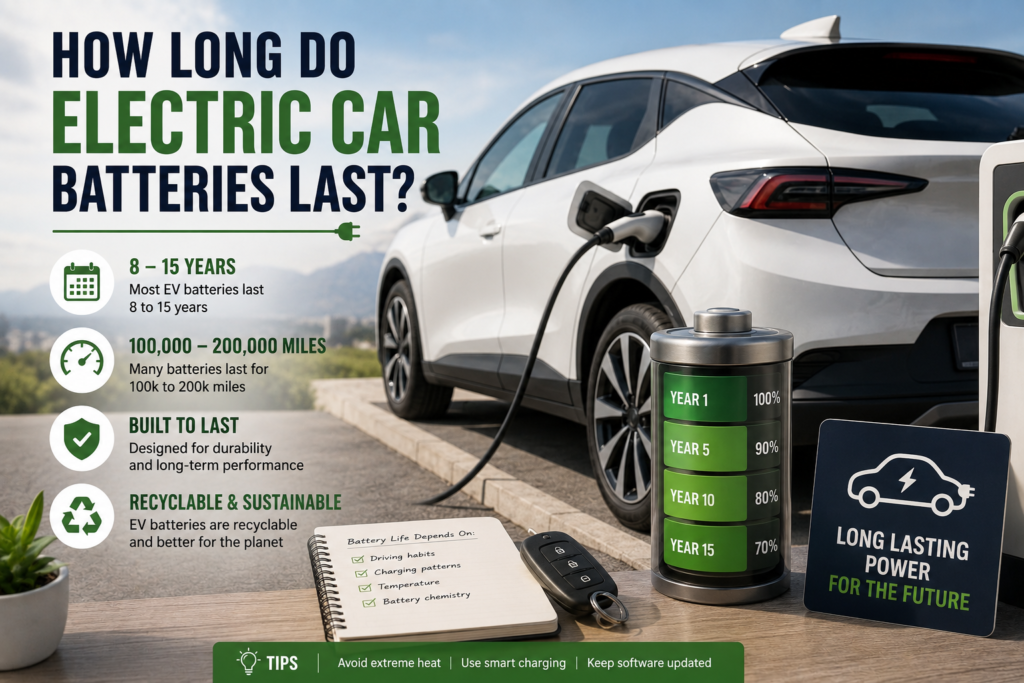
Based on everything I have researched and observed, most modern electric vehicle batteries are designed to last well beyond what many people initially expect, often somewhere in the range of ten to twenty years, or several hundred thousand kilometers, depending on the specific vehicle, battery chemistry, and how it is used and maintained.
This does not mean the battery performs identically on day one and after fifteen years of use. Like all batteries, electric vehicle battery packs experience gradual degradation over time, meaning the total range the vehicle can travel on a full charge slowly decreases. What genuinely surprised me during my research is just how slowly this degradation tends to happen for most well built, modern electric vehicles, especially compared to the rapid degradation people are used to seeing in something like a smartphone battery.
Understanding Battery Degradation
Battery degradation refers to the gradual loss of a battery’s total capacity over time, which directly affects how far an electric vehicle can travel on a single charge. Every rechargeable battery experiences this to some degree, whether it is powering a laptop, a phone, or an entire vehicle.
From what I have gathered through my research, most electric vehicle batteries lose only a small percentage of their total capacity each year under normal usage conditions. Many manufacturers report average degradation rates of around one to two percent annually, though this can vary depending on the specific battery chemistry, climate conditions, and charging habits of the owner.
What this means in practical terms is that after several years of ownership, most electric vehicle owners can expect their car’s maximum range to decrease somewhat compared to when it was brand new, but not dramatically enough to make the vehicle impractical for typical daily use.
Manufacturer Warranties and What They Reveal
One of the most useful things I discovered during my research was just how much manufacturer battery warranties reveal about expected battery longevity. Most major electric vehicle manufacturers offer battery warranties covering a significant number of years, commonly around eight years, along with a substantial mileage threshold, often somewhere between one hundred thousand and one hundred fifty thousand kilometers, depending on the specific manufacturer and model.
These warranties typically guarantee that the battery will retain a certain minimum percentage of its original capacity throughout the warranty period, often around seventy percent or higher. To me, this offered real reassurance, since manufacturers would not offer such lengthy, capacity backed warranties if rapid battery failure were a common, expected outcome.
I would strongly encourage anyone researching a specific electric vehicle to look closely at that model’s exact battery warranty terms, since coverage can vary meaningfully between manufacturers and even between different models from the same manufacturer.
Factors That Genuinely Affect Battery Lifespan
Through my research, I learned that several specific factors play a significant role in how quickly or slowly a battery degrades over time. Understanding these factors helped me feel more confident about how I could personally influence my own battery’s long term health.
Charging Habits
How you charge your electric vehicle genuinely matters. Frequently charging to one hundred percent capacity and regularly allowing the battery to drop to very low charge levels can accelerate degradation over time compared to keeping the battery within a more moderate charge range for daily use. Many electric vehicle owners, myself included, have adopted a habit of charging to around eighty percent for regular daily use, reserving a full charge only for longer trips that genuinely require the extra range.
Frequent Fast Charging
Relying heavily on fast charging stations, while convenient, can contribute to faster battery degradation compared to primarily using slower home charging methods. This does not mean fast charging should be avoided entirely, since it remains an important convenience for longer journeys, but consistently relying on it as your primary charging method rather than an occasional convenience appears to have some impact on long term battery health based on what I have read and observed.
Climate and Temperature Exposure
Extreme temperatures, both very hot and very cold, can affect battery performance and, over time, contribute to faster degradation. Most modern electric vehicles include battery thermal management systems designed specifically to protect the battery from extreme temperature exposure, which has genuinely improved battery longevity compared to earlier generations of electric vehicles that lacked this kind of protection.
Driving Habits
Aggressive driving, involving frequent hard acceleration and heavy use of regenerative braking under extreme conditions, can place additional strain on the battery compared to smoother, more moderate driving habits. This is not something that dramatically shortens battery life on its own, but it is a factor worth being mindful of if maximizing long term battery health is a priority for you.
What Happens When a Battery Does Eventually Degrade Significantly
I was also curious about what actually happens once a battery does degrade significantly over many years of use. From what I have learned, a heavily degraded battery does not simply stop working entirely. Instead, the vehicle’s maximum range gradually decreases, meaning the car can still be driven and charged normally, just with a reduced total distance available on a full charge compared to when it was new.
For many owners, especially those primarily using their electric vehicle for shorter daily commutes rather than long distance travel, a moderately degraded battery may still comfortably meet their everyday needs even after many years of ownership.
Battery Replacement: What I Learned About Cost and Likelihood
Battery replacement remains one of the most feared aspects of electric vehicle ownership, and I wanted to understand this realistically rather than relying on dramatic headlines. Based on my research, most electric vehicle batteries are genuinely built to outlast the typical ownership period of the vehicle itself, meaning many owners will never need a full battery replacement during the years they actually own the car.
That said, for owners who keep their vehicle for a very long time, well beyond the typical warranty period, or for buyers purchasing a used electric vehicle with an already expired battery warranty, battery replacement remains a real possibility worth financially preparing for. Replacement costs can vary significantly depending on the vehicle and battery size, and I would recommend anyone concerned about this specifically research current replacement costs for the exact model they are considering.
How Real World Experience Compares to the Numbers
Beyond the research and manufacturer claims, I also spent time talking with other electric vehicle owners and reading through real world experiences shared by long term owners online. The general consensus I found genuinely aligned with the research. Most owners reported relatively minor range reduction even after several years and significant mileage, with the vehicle still comfortably meeting their daily needs.
A smaller number of owners reported more noticeable degradation, often tied to specific factors like frequent fast charging, extreme climate exposure, or simply owning an earlier generation electric vehicle with less advanced battery technology compared to newer models.
This real world perspective genuinely reassured me more than the manufacturer statistics alone, since it reflected actual, lived ownership experience rather than controlled testing conditions.
Tips I Personally Follow to Help My Battery Last Longer
Based on everything I have learned, I have adopted a handful of habits that I believe genuinely help protect my own vehicle’s battery health over the long term.
I try to avoid regularly charging to a full one hundred percent unless I specifically need the extra range for a longer trip. I also try to avoid letting the battery sit at a very low charge level for extended periods of time, since this can also contribute to unnecessary strain.
Whenever possible, I rely primarily on home charging rather than public fast chargers, reserving fast charging for situations where it genuinely makes sense, like a long road trip. I also try to park in shaded or temperature controlled areas when possible, particularly during extreme weather, since this helps reduce unnecessary temperature related strain on the battery.
What I Would Tell Someone Considering an Electric Vehicle
If someone came to me today asking whether battery longevity should worry them before switching to an electric vehicle, I would honestly tell them not to let this concern hold them back from making the switch. Based on everything I have researched and experienced, modern electric vehicle batteries are built to last a genuinely long time, often outlasting the typical period most people keep any vehicle before eventually upgrading or selling it.
That said, I would still encourage anyone in this position to research the specific battery warranty of whichever vehicle they are considering, adopt reasonable charging habits from the very beginning of ownership, and set realistic expectations about gradual, minor range reduction over many years rather than expecting the battery to perform identically forever.
Final Thoughts From My Own Research and Experience
After genuinely digging into this question, both through research and real world observation, I feel confident saying that electric car batteries generally last far longer than many people initially assume. Gradual degradation is a normal, expected part of ownership, but the pace at which this happens for most modern electric vehicles is slow enough that it rarely becomes a significant practical concern within a typical ownership period.
If you are asking yourself how long electric car batteries actually last before making your own decision about switching to an electric vehicle, I hope sharing everything I have learned gives you a clearer, more honest answer than the vague or overly dramatic claims often found elsewhere online. Based on everything I now understand, battery longevity is genuinely one of the least concerning aspects of electric vehicle ownership, not the biggest obstacle it is sometimes made out to be.